News: Observatory rates entire 75-home site as "high concern"
The Science and Technology Facilities Council, which runs the Observatory, has sent a more detailed objection to James Painter’s proposed 75-home development. In it they explain the work done at the Observatory, including for the National Space Operations Centre.
They have also assessed the field Northeast of Drove Road, and sensationally have determined that the entire development site “will materially impact the Observatory operations”.
Mr Adam Trigg, who is Head of Estate Development at STFC, says that the new document “includes our more nuanced perspective on the proposed development which highlights where we have the highest concern, versus the parts where we think impacts will be negligible”.
He adds “We may reinforce our representation with further correspondence from other STFC partners as they are received”.
Activities at the Observatory site
The document outlines the activities undertaken at the site, and incudes notes from the people responsible for them, to support the objection.
Environment Agency
The document repeats much of what the Environment Agency explained in their request for conditions on the 75-home development, but adds more detail. It says “The Chilbolton Air Quality Supersite is a long-established and nationally important facility whose effectiveness relies on the stability of its surrounding environment”.
National Space Operations Centre
A note from the National Space Operations Centre explains that NSpOC “develops and operates the UK’s space surveillance and protection capabilities. NSpOC provides warning and protection services primarily to UK-licensed and government departments”.
The Observatory uses sensors to “provide observations of artificial space objects” using both radar and optical telescopes. This data is provided to NSpOC to “assist in the objects orbit determination”.
The note concludes by saying “Any development that could degrade the Observatory’s current and future capabilities could impact NSpOC’s mission sets that support the UK’s space surveillance and protection”.
Security risk
The document claims that “The new housing development will significantly increase the risk to the site”, which is a “unique facility to the UK Science and Space sectors”. It says that STFC will consult with “the relevant security services regarding the elevated threat”.
Devices that would be affected
- The 25 metre antenna provides atmospheric studies and precise spatial data on orbiting objects. Houses built to the North would compromise this work by increased electro-magnetic interference. The Observatory is planning an upgrade which would make the facility even more sensitive
- The Low-Frequency Array is spread over seven European countries and is used for deep space observation. The increase in electro-magnetic noise from the new houses would “drown out the signal, effectively rendering the antenna inoperable”
- C12 Optical telescope would be affected by light pollution making “observations to the North at low elevations unviable”
- The C13 Ground Station also contains an optical telescope which would be affected by light pollution
Site analysis
Helpfully, the document provides a risk analysis of houses built within the field next to Drove road. It classifies the risk into three categories:
- High concern: Dwellings in this zone will materially impact the Observatory operations (Lime green hatching)
- Medium concern: Single storey dwellings in this zone will be tolerable and any impacts on the Observatory will be negligible (purple hatching)
- Low Concern: Two-storey houses in this area are tolerable and any impacts on the Observatory will be negligible (Yellow hatching)
The analysis “tests the visibility of the radar dish at a height of 34m from a 9m building”. It includes assumptions about building and vegetation height and that there would be seasonal variations.
It carries the warning that the plan “is indicative and should be used to inform only, it is not evidence or proof of visibility to and from the radar dish”.
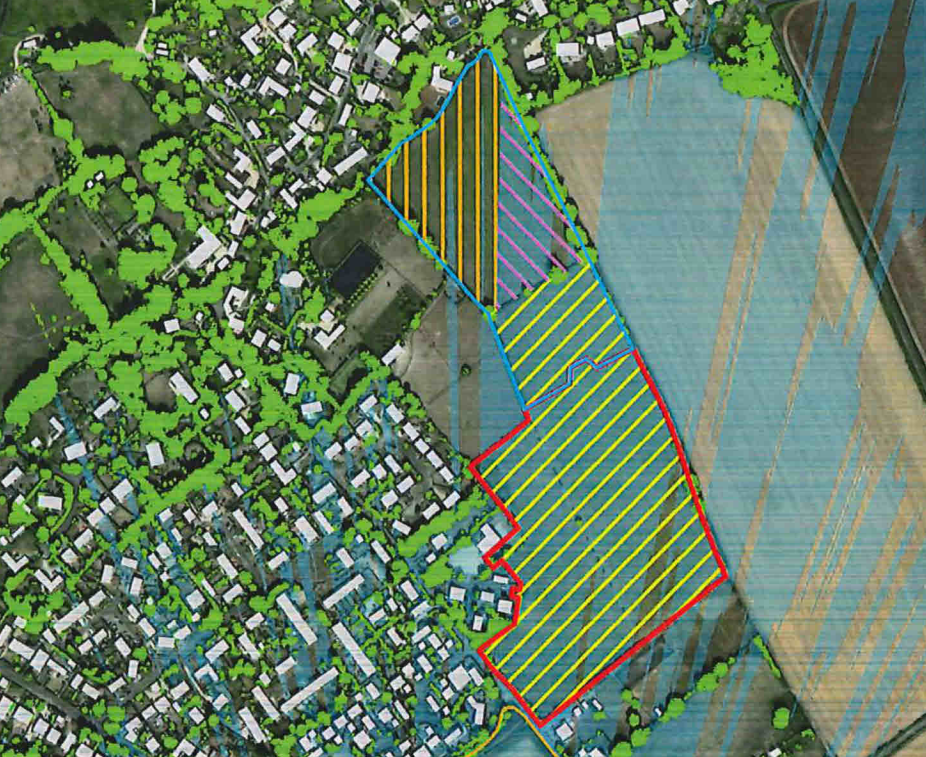
Zone hatching: Lime green: high concern, Purple: medium concern. Yellow: low concern
The analysis shows that the all the proposed 75-homes are located in the high concern category.
Summary
This new representation from STFC adds an extra level of detail, which goes a long way to explaining the concerns they raised last December.
However, where before they said that any issues could be mitigated by reducing the height of the new homes and reducing the density of development, it now appears that building any homes where the planning application sites them would cause serious problems to the Observatory.
The revelation that the National Space Operations Centre values the service it receives from Chilbolton so highly is striking. Their contribution refers to their “mission sets”. A quick glance confirms that these include:
- protecting and defending the UK’s space interests
- missile warning
- uncontrolled re-entry early warning
- in-space collision avoidance
Which puts things into a completely different perspective.
Mr Trigg’s closing remark to Planning Case Officer Emma Jones says “Please do update us on any pending committee date when this becomes clear”, which sounds like STFC might want to make a formal representation at the Northern Area Planning Committee.