News: Consultants rebut the Observatory's case
James Painter’s consultants, Southern Planning Practice have lodged three new documents with Test Valley Borough Planners.
In them they present analysis claiming that the proposed 75-home development would not interfere with Observatory operations, and that their objections to the development should be given little or no weight.
Three new documents
The three documents are:
- An analysis by Pager Power consultants which assesses the risk of radio interference from the proposed development
- A legal opinion by Gregory Jones KC of Francis Taylor Building chambers which assesses the weight that TVBC planners should attach to the Observatory’s objections
- A letter from Lawrence Chase, Principal Planner for Southern Planning Practice, which summarises the above assessments and describes the wider planning context of the Observatory
New houses won’t interfere with the Observatory
Pager Power are a consultancy which describe themselves as “Specialists in assessing and solving worldwide planning issues”. They present a series of desk-based technical analyses which they say demonstrate:
- The new homes will be below the line of sight of both the 25 metre antenna, and the Low Frequency Array telescope (LOFAR)
- Electronic emissions from the new homes will not substantively increase those that arise from existing homes in Chilbolton
- The power of emissions from households are “orders of magnitude lower than the [25 metre antenna] radar’s operational signal levels, and would not be expected to have an effect on its performance”
- Emissions from vehicles and street lighting are unlikely to affect Observatory systems given their distance from it and absorption by the ground
- The Observatory already has means for filtering unwanted radio-frequency noise
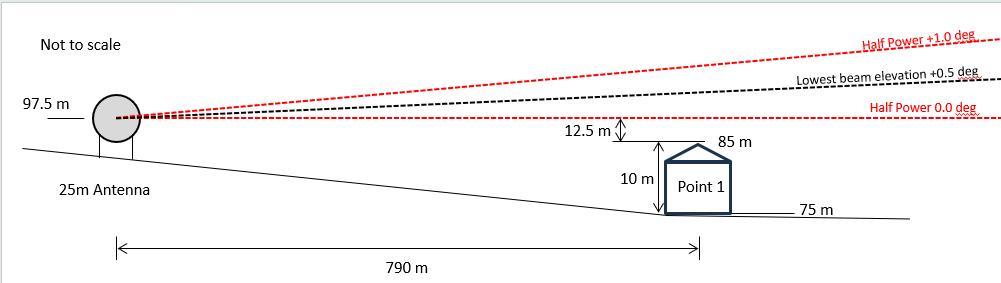
Vertical beam analysis for the point closest to the Observatory (Credit Page Power)
“Limited or no weight”
Gregory Jones KC presents an opinion which attacks the Observatory’s objection by saying that it doesn’t provide an explanation of exactly how its operations would be compromised by the proposed 75 homes. Nor does it provide backing for the assertion that there is no mitigation that Mr Painter could provide to allow his scheme to go ahead.
These deficiencies in their objection cannot be helped, he says, by saying how serious the effect would be on “national scientific functions” or that senior staff at the Science and Technology Facilities Council support the objection.
In contrast, while acknowledging that Pager Power’s assessment might not be accepted “in every detail”, he describes it as “reasoned, structured and capable of evaluation.”
As a result of this, he rates the Observatory objection as not justifying “anything more than limited or no weight”, by planners in making their decision. He concludes by saying “Permission should therefore be granted.”
Frustration with STFC
Lawrence Chase of SPP begins by summarising their interactions with the STFC. He notes a hardening of their position between their first and second objections. He adds that following a meeting with them in July, further correspondence with STFC indicates that they “wish to reinforce the objection further.”
He concludes from this that “despite a seeming willingness to engage; it is considered that the Observatory is unlikely to positively work with the applicant to quantify what impacts (if any) the development would actually have on operations at Chilbolton Observatory.”
This frustration led to SPP’s commissioning of the Pager Power analysis, which he summarises saying “even when assessing against the worst case, the level of interference emanating from the development is considered negligible.”
He also looks to previous planning decisions in Chilbolton, observing that
- Other developments have been approved without any objection from the Observatory
- Unlike Jodrell Bank, there is no policy for the Observatory in the existing Local Plan, or the one that was recently abandoned
- The site has not been registered as critical infrastructure or for national security purposes
He concludes by saying:
The importance of Chilbolton Observatory and the valuable scientific work undertaken there is fully acknowledged, and nothing in this response seeks to diminish it. However, as established by case law, it is the evidential basis of an objection, rather than the standing of the objector, that determines the weight it should attract. Tested against that standard, the concerns raised are not substantiated by objective analysis.
He echoes Gregory Jones’ opinion by submitting that only limited weight should be attached to the Observatory’s objections