Exclusive: Observatory plans for higher frequency radar
An academic presentation and a contract tender have revealed plans to add a higher frequency radar to the Observatory’s 25 metre antenna. This would supplement rather than replace the existing S-band radar.
Plans for the Chilbolton 25m antenna
In September 2025, the European Conference for Amateur Radio Astronomy was hosted for the first time by the Rutherford Appleton Laboratory at Harwell.
One of the speakers was Professor Ian McCrea, veteran of 30 years at RAL, and Head of its Space Physics and Operations Division. He was to speak about space weather instrumentation, measurement, modelling and risk (SWIMMR), a £20 million, four-year programme to improve the UK’s capabilities for space weather monitoring and prediction.
Weather radars and satellites
He was talking about the development of space weather radars in Europe, and radio techniques for observing the ionosphere. He showed a radar display, and to his knowledgeable audience said “I’m sure you’ll recognise this as a hard target display” - a satellite. For space weather monitoring, he said “we now have to take measures to excise those from the data.”
He then diverted from his main topic saying “That has spawned a whole new area of radar science for us at the lab because we are using one of our radars in the UK to track those targets.”
Space Surveillance and Tracking at Chilbolton
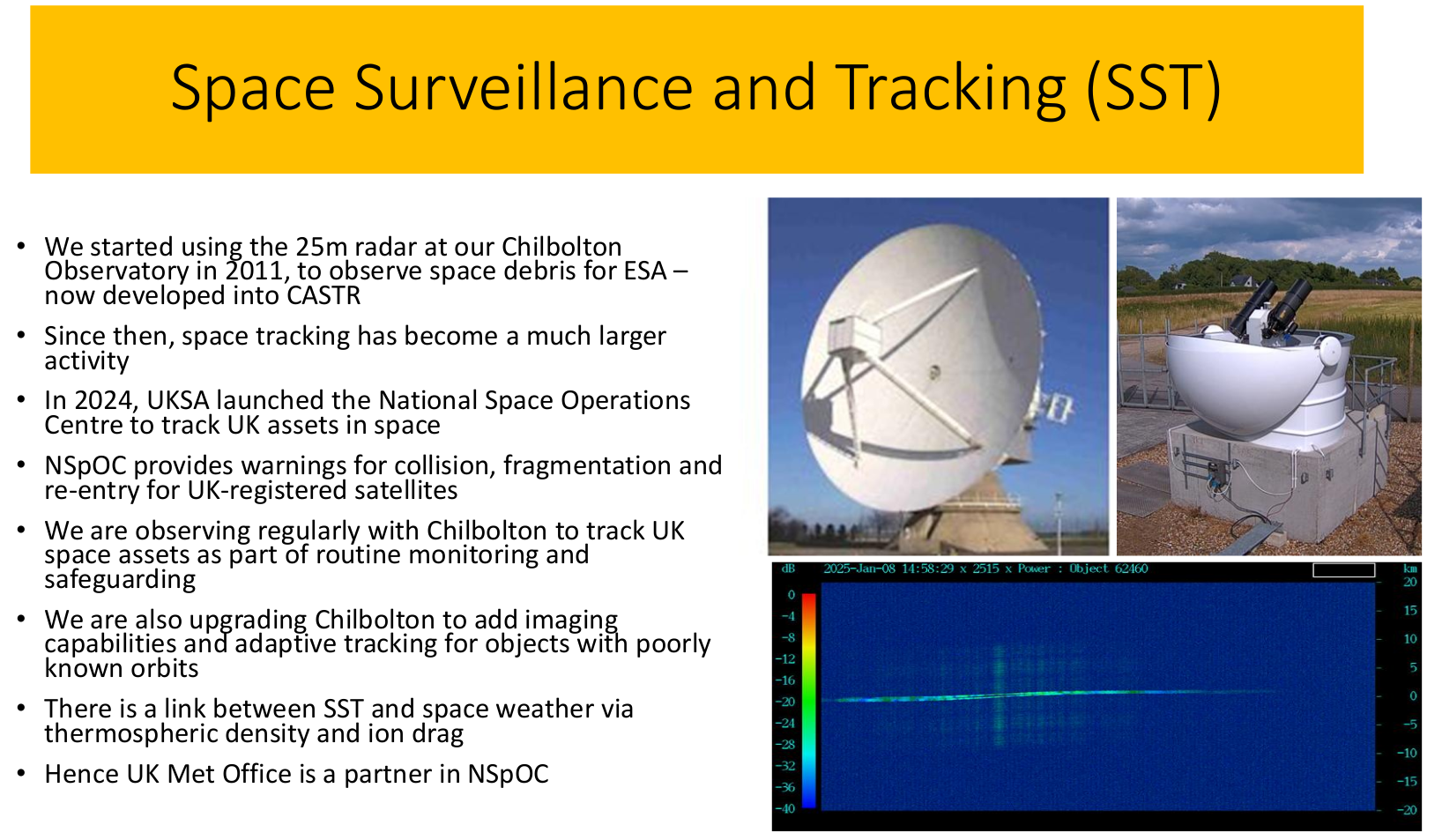
Space Surveillance and Tracking at Chilbolton (Credit: Prof. Ian McCrea)
He described the work at Chilbolton in more detail. He said they used radar to “to track those hard target echoes for UK-owned and UK-registered satellites as they appear over the horizon, and track them at least for a subset of their paths so that we can verify the parameters of orbit.”
He went on to say how they could “Also [do] the same thing optically - an optical system called COATS whose motion can be slaved to the motion of the radar, and vice versa so we can track the same object both radar and optically.”
Tracking since 2011
He said that Chilbolton had started satellite tracking for the European Space Agency in 2011. Since 2020, after Brexit, he said that they had been tracking for the National Space Operations Centre (NSpOC). He said “It’s a joint collaboration between the UK Space Agency and the MOD. That’s an very interesting model - No other country does a joint civil/military space tracking centre as far as I know.”
The tracking reveals the range and position of the targeted satellite. Prof. McCrea said “most of the time they’re very predictable. The times when they aren’t predictable, are the times when we have significant space weather, that increases the atmospheric drag and can perturb orbits.”
He also mentioned satellites that are close to re-entering Earth’s atmosphere: “They’re low altitudes, area of quite variable drag, that can rapidly modify their orbits. Knowing that is important because if something is going to fall on your head, you want to know where.”
Antenna upgrades
He then outlined upgrades that they were making to Chilbolton’s 25 metre antenna:
We are going to add a new feed to it which allows multiple beams from the same radar. The reason we’re doing that is so that we can centre our target. So if we are tracking a nominal orbit, but the satellite is one side or the other, the balance in the signal of those four beams will tell us how we’re off so we can correct.
The other thing we’re doing is we are adding a higher-frequency capability and a bigger bandwidth of reception and the idea is that this will allow us to do some radar imaging. We can observe not just the detection of objects, we can do some level of characterisation as well. So if there is a satellite, for instance, that hasn’t got a solar panel unfurl, we can start diagnosing that kind of problem with our radar. Some countries are already doing that.
Contract for an X-band radar
In February 2024, details of a contract worth £533,888, were published for amendments at Chilbolton Observatory to install an X-band radar. The specification described the work to be done:
The Chilbolton observatory operates a 25m diameter, prime focus, parabolic reflector antenna with an F/d ratio of 0.36. The antenna was commissioned in 1967 and has for many years been used with an S-band radar fed from the prime focus point. The main feed is undergoing an upgrade to implement monopulse tracking. At the same time the observatory would like to add a wide band X-band radar to the antenna for simultaneous operation with the S-band radar. The intention is to use the S-band radar for tracking and ranging of satellites while the wide bandwidth X-band radar is used for imaging.
This revealed two things. First, the S-band feed was being upgraded to add the ability to acquire both the distance to a given satellite target, and its direction.
Second, an X-band radar was to be added to the 25 metre antenna which would allow far greater detail of a satellite target to be gleaned.
Because of the design of the antenna, the proposal was for a novel arrangement by which the two radar devices would work together. It would take advantage of a technology called Frequency Selective Surfaces which allow different electromagnetic frequencies to be reflected, transmitted or absorbed.
The proposed design would allow the existing S-band waves to pass thorough an FSS reflector, while X-band waves would be reflected from it allowing both radars to operate simultaneously.
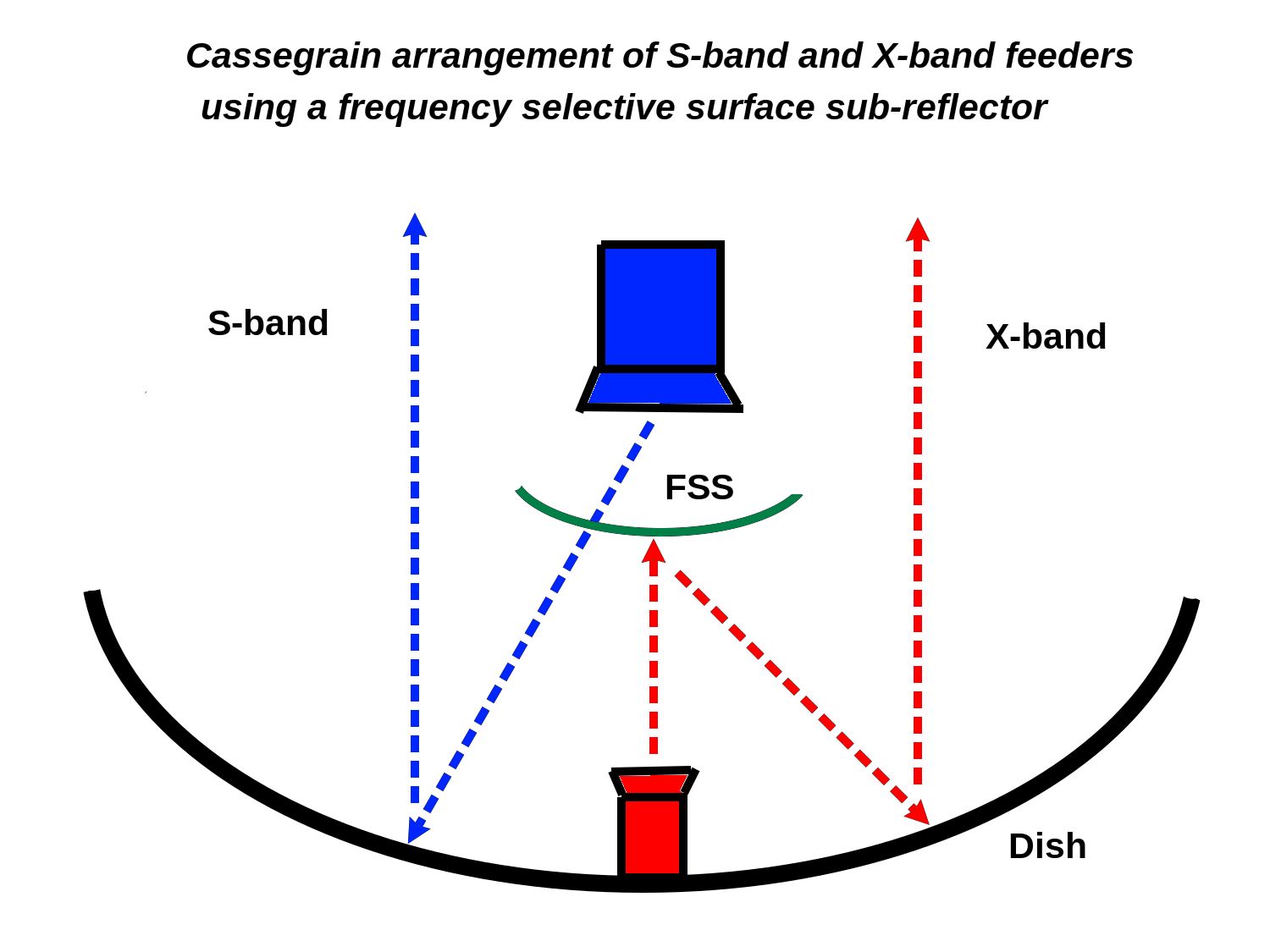
S-band and X-band share the antenna with X-band feed reflected by FSS surface
The contract was awarded to KTF Services LLC of Judson, Texas, with a delivery date of 31 Mar 2025. They were also awarded a contract for a survey of the dish at the Observatory worth £67,146.
How does X-band radar differ from S-band
X-band radar operates in a frequency range of 8 to 12 GHz. With short wavelengths it can be used for applications that require detailed imaging, such as detecting small objects. It is used in satellites for both civilian and military purposes, with imaging of the Earth’s surface.
S-band radar operates at between 2 to 4 GHz. Their longer wavelengths penetrate atmospheric particles effectively, making them suitable for long-range applications, including satellite tracking.
However, while X-band provides greater detail than S-band, it suffers from being more easily affected by unwanted echoes from rain, vegetation, and buildings.
Both types of radar are used on marine vessels. Some ships will have both, and when they do X-band is used for precision close-range navigation and detection of buoys, small craft and debris. S-band is used during ocean passage or in heavy rain.
The beam can deflect 2 degrees below level
By sharing the 25 metre antenna with the S-band sensor, the X-band device will enjoy the same range of elevation, which will be particularly important to low elevations from the northern horizon.
We have already called into question beam height predictions in Pager Power’s Radio Telescope Impact Assessment. Our own desk-based analysis concluded that the lower part of the beam from the 25 metre antenna was 1.2 degrees below level, from conservative assumptions about its elevation.
Even that analysis now turns out to be too conservative. A scientific paper from 2017 gives the full specification of the CASTR sensor. It says the elevation goes from minus 2 degrees to 92 degrees. In other words the beam can deflect a full 2 degrees below level.
The result of this is that homes at all five points chosen by Pager Power, and using their method of calculation, would be fully intercepted by the beam from the antenna.
| Point | Elevation | Clearance |
|---|---|---|
| Point 1 | 75 | -10.7 |
| Point 2 | 72 | -13.2 |
| Point 3 | 72 | -18.8 |
| Point 4 | 74 | -15.0 |
| Point 5 | 71 | -14.3 |
In other words, the planned 75 homes would all be in the way of both S-band and X-band radars.
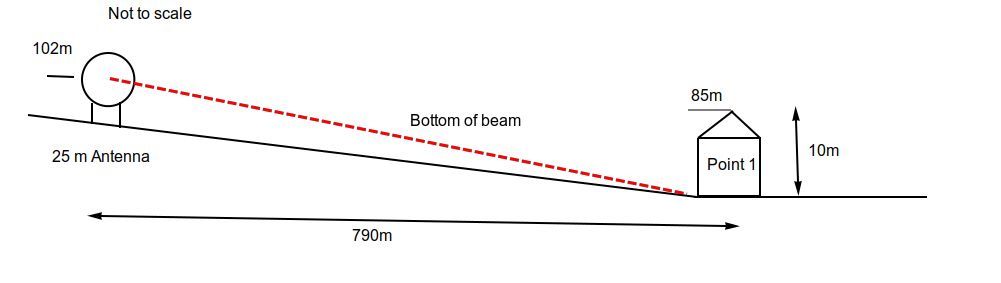
A 2-degree declination beam, using Pager Power modelling
The implications for the 75-home development
S-band
The knowledge that the maximum deflection of the CASTR S-band sensor is 2 degrees below level supports STFC’s objection: no homes could be built on the proposed site without affecting its performance at low elevations.
X-band?
Publicly available information does not give any indication of how much progress has been made in designing, constructing and installing an X-band radar at Chilbolton.
However, it may explain one paragraph from STFC’s objection to the 75-home development:
An upgrade to the facility is currently being planned which will deliver a more sensitive sensor - this will make the facility even more sensitive to electromagnetic interference from nearby houses.
An X-band radar would certainly fall into that category. With its much higher resolution of objects, it would meet Prof. McCrea’s wish to be able to detect faults on satellites. Its greater sensitivity to radar clutter caused by buildings or trees would also explain STFC’s concerns about electromagnetic interference.
Tracking from the horizon
Prof. McCrea also gave details of how the existing S-band radar is used in conjunction with the Chilbolton Optical Advanced Tracking System (COATS). This is an optical telescope that works together with the S-band radar “so we can track the same object both radar and optically.”
He said that this is done as satellites “appear over the horizon.”
The STFC said of the optical telescope that it “would be affected by light pollution from additional new houses which will render observations to the North at low elevation unviable.”
The Pager Power analysis doesn’t mention the COATS optical telescope. Prof. McCrea said that both devices could be slaved to each other. In other words, information from either device can be used to drive the positioning of the other.
This means that COATS is an integral part of the satellite tracking process at the Observatory. It is sited much lower than the 25m antenna, and therefore its line of sight to the horizon is more likely to be compromised by new dwellings nearby.
Public domain
Everything that we’ve reported here is in the public domain. We await with interest what the STFC choose to make available in any future comment on the 75-home proposal.