Comment: The 75 home plan one year on
Today marks the first anniversary of a planning application appearing on Test Valley Borough Council’s website to build 75 homes outside the settlement boundary within Chilbolton.
Here we look back at the unprecedented effect it has had on the Village and its residents.
An unfortunate start
In November 2025, the fact that the application had been lodged did not come as a great surprise. Almost a year before, the intentions of the landowner, James Painter, had been revealed in a disastrous Village meeting hosted by the now-notorious Strategic Working Group.
Their work with him over a period of many years had resulted in a phased plan to build 168 homes on agricultural land he owns. The SWG’s intention to charm Villagers with the prospect of a 25-home development on that land was exploded when the full plan leaked.
That reveal set the tone for villagers - one of implacable resistance to the “secret” plan.
Working together with the Parish Council
Nonetheless the Parish Council continued to work with Mr Painter. Two things motivated that. First, the Village’s Neighbourhood Development Plan called for the building of “about 20 homes” over a 10-year period, based on a housing needs survey. The site offered the opportunity to fulfil that plan.
Second, the Painter family had generously donated land on which the homes at Eastman’s Field and the Village Hall had been built. An understanding that they could build executive homes nearby, as a quid-pro-quo, was never fulfilled.
However, things did not go smoothly. A pre-application for 25-homes at the site was botched and had to be resubmitted. Test Valley Borough Council’s response to it, said that the “the submission of a planning application would not be supported at this time” because there was little evidence of community leadership or sustainability.
Going it alone: a 75-home plan
James Painter’s partnership with the Parish Council began to crumble with a letter he wrote to its Chair saying he intended to go it alone with a planning application for 25 homes. He said he hoped to continue to work with the Parish Council.
Those hopes were later dashed when he finally submitted an outline plan for 75-homes. A plan that left no doubt over his intentions, one day, to fully develop the entire site.

Proposed 75-home development site and access
This pivot, away from a plan involving the Village to a commercial one, would prove to be a mis-step. It hardened resolve within some Parish Councillors against his development, and opened a weakness within his application: it was outside the settlement boundary and was no longer “community-led”.
Rallying opposition
The Parish Council acted quickly to mobilise its own response, organising meetings to glean residents’ views, and encourage them to provide their own comments on the plan. They even organised their own traffic survey.
The local MP, the Rt Hon Caroline Nokes, addressed villagers. She pointed out that Chilbolton had a Neighbourhood Development Plan, and that objections could be raised about sustainability and traffic. However, she said that local councillors would make their decisions on valid planning grounds. She warned that “I cannot wave a magic wand and make this go away.”
Cherish Chilbolton was formed, and was soon busy leafleting the Village and putting up signs, selling campaign mugs, and even hosting a coffee morning.
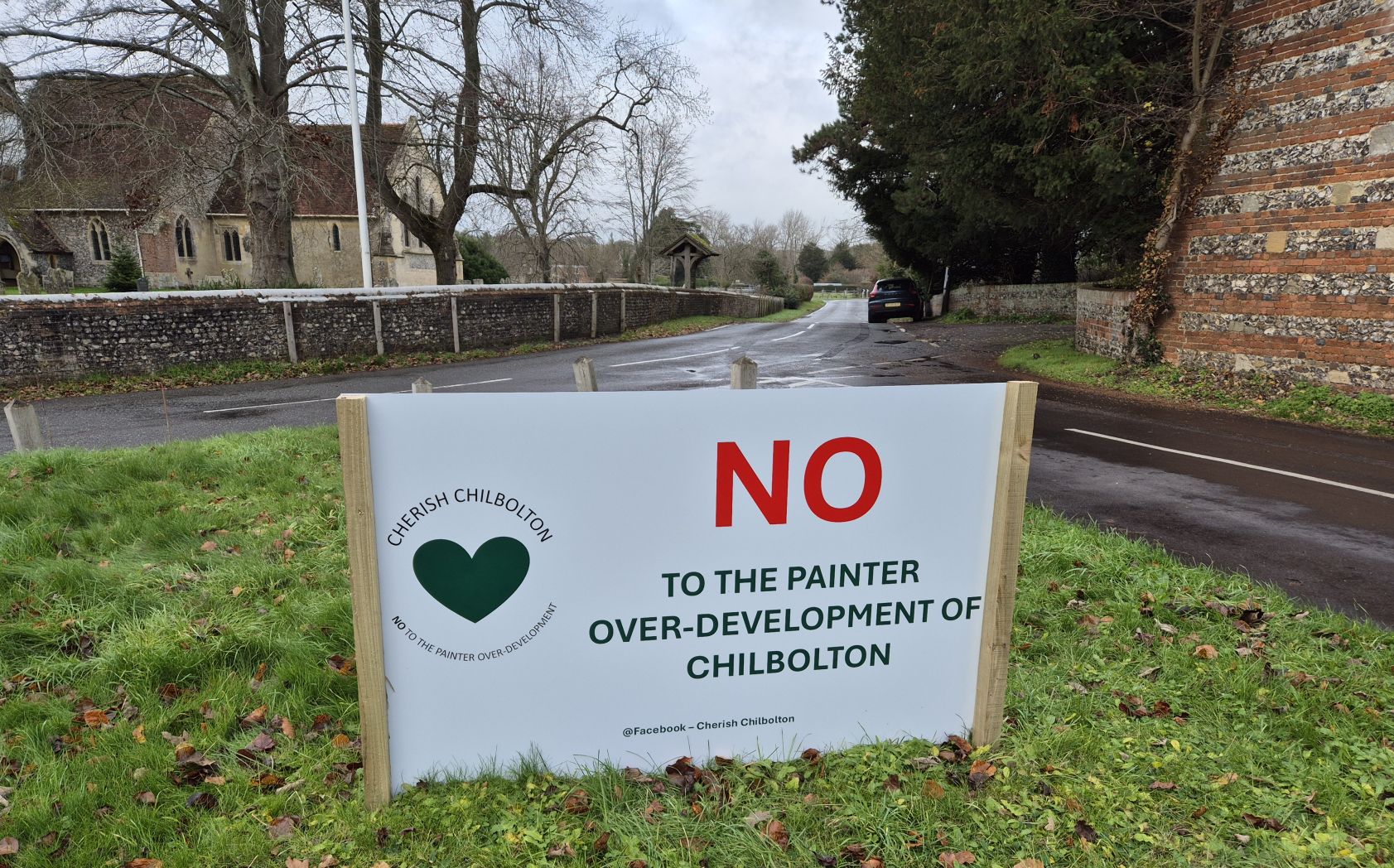
The short-lived campaign sign on Stocks Green
The plan to fire up Chilbolton residents worked: by the determination date of 11 Feb 2026, they had lodged 244 comments, of which 239 were objections.
Interestingly, although a total of fifteen people were part of the SWG, and attended its meetings, only two ventured to support the planning application with a comment.
The responses were varied and at times ingenious, but some themes cropped up again and again: increased traffic on narrow winding roads and the safety implications; existing problems with sewerage infrastructure and local flooding; and the plan represented over-development in the Village, ignored the Neighbourhood Development Plan and would change the character of Chilbolton.
A novel objection
One of the public comments was an intriguing prospect. It wasn’t from a simple member of the public, but from the Head of Development at the Science and Technology Facilities Council. And it raised a point that nobody else had raised.
Mr Adam Trigg said that the proposed development would interrupt Chilbolton Observatory’s “clear horizon”, and it would also affect their sensitive instruments with electromagnetic interference.
Nonetheless, he held out the hope that the plan could be altered to mitigate these problems, albeit involving a reduction in the height of the new homes and the density of development.
This objection, and those raised by residents and consultees caused Mr Painter to request an extension to the determination deadline, which TVBC planners agreed to, allowing him until 24 Apr 2026.
Devastating news
On 30 Apr 2026, novelty turned into what seemed to be an existential threat to the 75-home plan. Mr Trigg supplied a second objection, endorsed by the National Space Operations Centre - a body tasked with overseeing the UK’s space surveillance and protection capabilities, including the work done at Chilbolton Observatory.
The objection stated that all the homes planned for Mr Painter’s site would materially impact the Observatory’s operations. Operations which are essential for national safety and security. No hope of mitigation by rejigging the plan was held out.
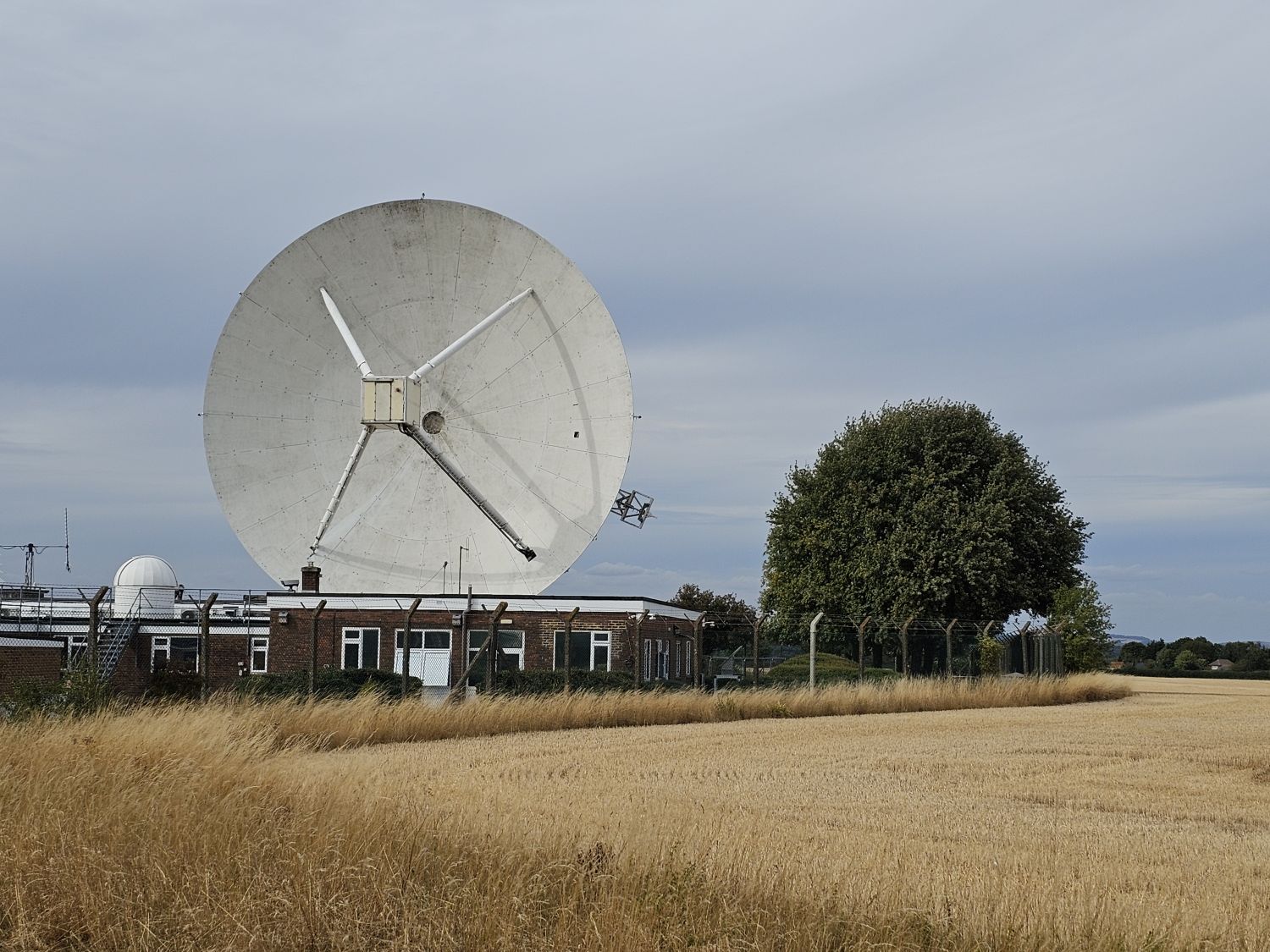
The 25 metre antenna at Chilbolton Observatory
James Painter acted quickly, and commissioned consultants Pager Power to rebut Mr Trigg’s objection. They asserted that new homes would be below the line of sight of both the Observatory’s 25 metre antenna, and the Low Frequency Array telescope.
He also engaged a barrister who said the Observatory’s objection compared poorly with Pager Power’s analysis which was “reasoned, structured and capable of evaluation.”
However, the Pager Power analysis was soon criticised for faulty modelling, not taking account of the optical telescope on site, and ignoring the planned upgrade to a more sensitive radar.
Worse was to come when it emerged that the government had set aside £7m to upgrade the Chilbolton radar as part of £880m to boost UK space intelligence surveillance and reconnaissance capability.
An alternative site for affordable homes
With the 75-home plan now being a commercial venture, and one which was at risk of refusal by planners, the Parish Council began a search for an alternative site for the affordable homes required by their Neighbourhood Development Plan.
Gravel Hill was a site that had been flagged to Parish Councillors as far back as 2024. However it had then been ignored, given the SWG’s work to promote James Painter’s development.
A review of potential sites around the Village now brought Gravel Hill into focus and it emerged as a viable prospect.

Visualisation (Credit: CPC/English Rural/PDP Architecture)

James Painter implicitly acknowledged the seriousness of the proposals. He commissioned an “independent” report by his planning consultants into the Gravel Hill proposal which concluded that it “should never have progressed to site feasibility stage.” In contrast, his own site - Drove Road - was “suitable, available and achievable.”
Mr Painter also emailed Village residents with a document which compared a 20-home development at Gravel Hill unfavourably with a 25-home development at Drove Road.
The Gravel Hill proposal was discussed at a public meeting and the Parish Council revealed that it would be put to villagers as part of a public consultation.
Although electors in Chilbolton had previously endorsed the Neighbourhood Development Plan in a 2021 referendum, this would be the first time they had a chance to vote on specific housing proposals.
Consultation
The results of the consultation, based on a remarkable 60% turnout of electors, endorsed the Parish Council’s approach.
Three things stood out: first, the proposal for up to twenty affordable homes at Gravel Hill was a comfortable winner. There was also strong support for community-led development in the Village. The most notable feature was that 77% voted the 75-home proposal as their least desirable option.
Where does the 75-home plan stand now?
With 347 documents associated with the outline planning application, 244 residents of Chilbolton, hailing from 25 streets in the Village, have objected to the proposal.
The Parish Council itself has lodged eight objections, each aiming to demonstrate how the harms of the proposal will outweigh the benefits.
These include a recent objection which points out that the new National Planning Policy Framework, published in August, raises the bar against development outside the settlement boundary making it much harder to gain approval.
Critically, it records that applications should be refused unless the applicant can demonstrate:
i) The site should be treated as an Exception Site under policy H10 which needs to evidence the need for affordable housing in a housing needs survey which is no more than 5 years old or is community led ii) The proposal evidences an unmet need. However, this must be of a scale which can be accommodated taking into account the existing or proposed availability of infrastructure
This alone should give Mr Painter pause for thought. Was his decision to abandon the Parish Council, and the benefits of community leadership, rash? What chance would he have, given the history of the last two years, of renewing that alliance?
However, he has much else to consider. He, and the rest of Chilbolton, await a substantive response from the Science and Technology Facilities Council concerning Chilbolton Observatory.
One might expect that such a response would have significant technical detail explaining how his proposals would interfere with its operation. It could also make clear the Observatory’s strategic importance to UK interests.
This may mean that none of the response can be made public.
It is a curious coincidence, that yesterday - ahead of the anniversary of the first publication of the plan - that a new objection appeared on the website. It is an objection from Mr Adam Trigg. There are no reasons given, and there are no comments. Is this some error? Or does it signify that planners have received documents that are secret?
What happens next?
If TVBC planners are minded to refuse the application, James Painter will have the option of withdrawing his plan or could accept the refusal and then appeal against it.
If the plan were approved, other options are open to the Parish Council. Like Braishfield Parish Council, they could ask Caroline Nokes to request the Secretary of State to “call in” the application. This would result in a review by the planning inspectorate.
Similarly CPC could, like Braishfield, raise a fighting fund to support a Judicial Review of the application.
Whatever happens, James Painter’s planning application already occupies a unique position in the history of Chilbolton. At times over the last couple of years, it has echoed Commander Sam Shore’s catchphrase in Stingray - “Anything can happen in the next half hour.”