Analysis: Why is TVBC moving to a "gateway" local plan process?
Test Valley Borough Councillors have agreed with their planners’ recommendation that the current Local Plan consultation will be halted and a new “gateway” Local Plan started in 2027. Why are they doing this, and what will it mean for Chilbolton?
At the July TVBC Council Meeting, Councillors voted 22 in favour of stopping the current Local Plan process begun in 2025, with 15 abstaining. The vote was along party lines, with the incumbent Conservatives in favour, and Liberal Democrats speaking against the motion, but abstaining rather than voting against.
Last week TVBC issued a rather tetchy press release that outlined the proposal, to move to the new “gateway” process, which will be completed by 2029.
In it they said about the Government:
Their complete lack of joined-up thinking, coupled with local government reorganisation has made it almost impossible for councils to produce sound and deliverable Local Plans that aren’t being overtaken by events. Despite best efforts to do the right thing, we can’t hold back the tide. This is not unique to Test Valley with many other local planning authorities, including Winchester and East Hampshire, switching to the new process and trying to coordinate a future plan that has regard to the new local government geography post-reorganisation.
The legacy Local Plan
In June 2025 TVBC published a Local Plan consultation document in which 65 homes were allocated to Chilbolton on land north east of Drove Road. This land was subsequently the subject of James Painter’s application for a 75-home development.
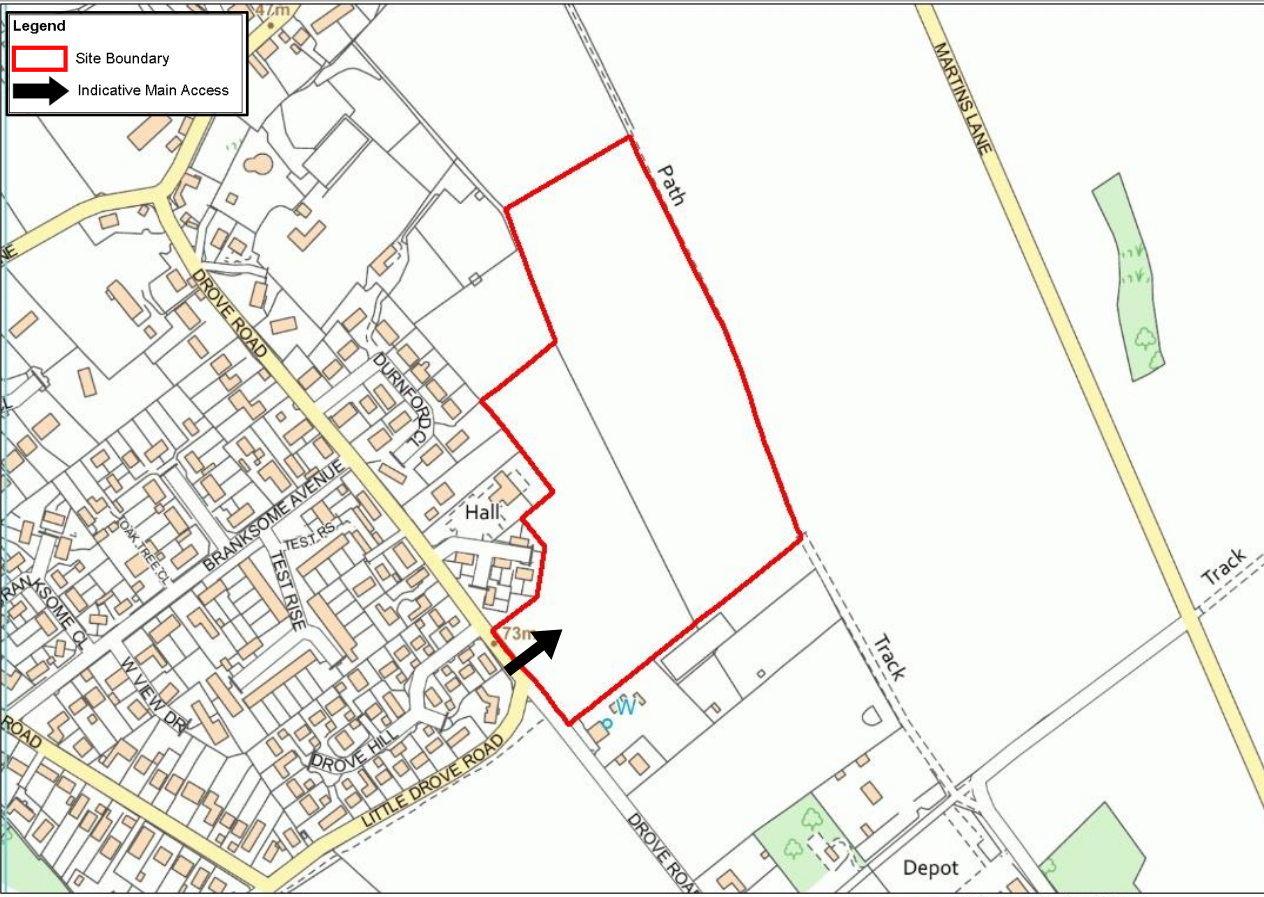
TVBC’s proposed 65-home site in Chilbolton (Credit: Test Valley Borough Council)
TVBC have put together a summary of Chilbolton’s responses to their Local Plan. They recorded 50 responses. The criticisms echo those made of James Painter’s plan with the notable exception of those concerning the Observatory, who did not comment on the Local Plan.
The Parish Council responded to the consultation saying that they supported 20 houses, and objected to any higher number. They referred to their own pre-application for 20 homes plus 5 self-build plots, saying:
The responses from Test Valley to the pre app state quite clearly the need for the development to be community led. The building therefore of as many as 65 houses flies in the face of these requirements and is certainly not community led.
Why do planners need to change course?
A tight deadline and a new planning process
The current Government process for producing Local Plans will cease on 31 Dec 2026. Planners would have to have submitted their Plan by that date. This had been TVBC’s aim.
If they missed that deadline they would have to restart using the new gateway Local Plan process, which has a strict 30-month schedule, with fixed checkpoints or “Gateways”.
Why can’t planners meet the deadline?
Two factors have put TVBC planners under pressure.
Speculative development is being put forward throughout the borough, effectively overtaking the emerging Local Plan. This means that infrastructure supporting these developments needs to be considered during the planning application, rather than as part of the Local Plan.
In addition, since the original consultation was launched, at three sites - Weyhill, Stockbridge and Appleshaw - owners have withdrawn their land. This amounts to a shortfall of 800 homes in the Local Plan.
Planners were faced with filling that gap with new allocations. In doing this they would have to decide whether there was time to consult with the public on them. If they did, they might not make the deadline. If they didn’t, the plan they produced would be weaker.
Couldn’t they ask for more time?
They could, but it’s not clear that any extension would be granted. Even if one were granted, it’s not certain that an effective and long-lasting plan would be produced.
Other authorities are making the same move
Winchester City Council published its notice to commence Local Plan preparation under the gateway system on 30 Jun 2026.
East Hampshire District Council announced on 28 May 2026 that it would no longer seek to submit a local plan by the end of the year, and that it would engage with the new gateway rules. They felt that continuing under the legacy system would be “pointless and unjustifiable.” They said:
Putting together a local plan is hugely costly and requires hundreds of thousands of pounds to engage expert consultants to advise on transport, utilities and more. Spending that amount of tax payers’ money on a document that would be of little use once completed is totally unjustifiable.
The announcements are relevant because TVBC will be joining these authorities within the new Mid Hampshire unitary authority when it assumes full powers in April 2028.
Using the same planning process as other authorities brings the advantage that the transition to unitary-wide Local Plans will be easier to co-ordinate.
So what’s different with this new system?
Fewer than one third of Local Planning Authorities have an up-to-date local plan. Under the legacy system local plans often took many years to progress from evidence gathering through to adoption. The Government’s intention is to ensure greater consistency across the country and to move towards full local plan coverage across England.
A key feature is that the new process will be undertaken within a strict timetable of 30 months. During that time there are three checkpoints or “gateways”, which will involve the Planning Inspectorate earlier to reduce the risk of issues emerging when the plan is finally examined by them.
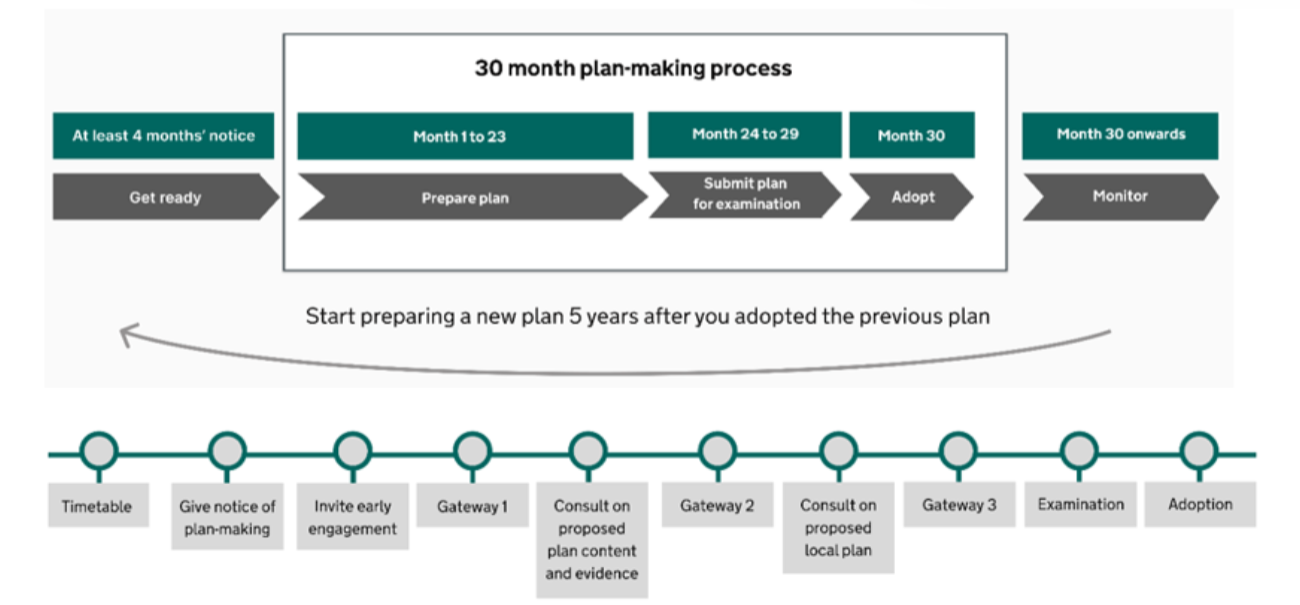
Gateways and a strict timetable
What are the gateways?
The 30 month clock starts ticking at Gateway 1 - the publication of a self-assessment which confirms that TVBC is ready to begin the process.
Gateway 2 allows the Planning Inspectorate to provide observations and advice on the emerging plan and evidence. They will typically do this within six weeks.
At Gateway 3 the Inspectorate checks whether the plan meets prescribed requirements and is ready to proceed to examination.
The observations and advice from Gateways 2 and 3 must be published.
TVBC Planners’ proposed timescale
| Stage | Dates |
|---|---|
| Publish Timetable and Notice to Commence plan making | Oct – Dec 2026 |
| Gateway 1: Complete and publish Self-Assessment Summary | By Apr 2027 |
| Gateway 2: Consultation on plan content and evidence | By Apr 2029 |
| Gateway 3: Consultation on proposed Local Plan | By Apr 2029 |
| Submission, Examination and Adoption | By Oct 2029 |
What about the risk of speculative development?
Planners will have the same aim under the new process as they did within the legacy process - to meet the new, higher Government housing targets for the Borough.
Of course it will take significantly longer to produce a new Local Plan, meaning the period during which the “tilted balance” in favour of sustainable development will be extended.
However, TVBC is likely to be at risk of this for some time thanks to a new method of assessing whether they are fulfilling the Government’s new targets - the Housing Delivery Test.
Housing Delivery Test
Effectively this is a rear-view mirror of how many new homes have been built rather than just planned. This test is made and published every year.
It is calculated as the number of new homes built in the Borough over the last three years, divided by the number of homes that the Government wanted built. It is expressed as a percentage.
The result of this percentage is:
- If HDT is 95% or more, no action is required
- If HDT is less than 95%, then an action plan needs to be drawn up
- If HDT is less than 85%, a 20% buffer is added to the planned housing supply, in addition an action plan is required
- if HDT is less than 75%, then the presumption in favour of sustainable development applies, a 20% buffer is added and an action plan must be produced
Planners anticipate that the 2025 HDT calculation for Test Valley will be about 55%. This means that even though TVBC have been granting permissions for speculative development, and are in the process of improving the five year housing land supply, the presumption in favour of speculative development would still apply.
A problem for years to come
These two factors - not having a sufficient five year land supply, and failing the Housing Delivery Test means that, according to TVBC planners, “the risk of speculative homes will continue for many years”.
Significantly though, they add that switching to the gateway Local Plan “will not therefore lead to a change in this position”.
What does this mean for Chilbolton?
Speculative development for longer
Along with the rest of Test Valley, Chilbolton will now face the threat of speculative development for at least two years more than we would have done, and probably even longer.
This risk is what the Parish Council have been hoping to fend off, by proposing a 20 to 25 home community-led housing development. These proposals will be voted on by residents as soon as August or September.
CPC are also working to refresh its Neighbourhood Development Plan, which specifies the sort of homes that residents believe the Village needs, and how many of them. A valid, current NDP still has some weight in planning decisions.
The 75-home proposal
The existing planning application for 75 homes was launched with Village-wide distribution of a flyer extolling its virtues, headed “Consulting the Community” and offering “new community facilities and spaces for sport, health and wellbeing”.
The planning statement which supported it, mentioned the connection with the draft Local Plan. The statement, under the heading “Emerging Plan”, noted this connection, but admitted “At this early stage it carries little weight.”
With the cancellation of the emerging plan and its “community-led” 65-home allocation, even that slim piece of support has disappeared. The 75-home plan is now just one more speculative development amongst many in Test Valley.
Observatory objection
When TVBC planners made their 65-home allocation to Chilbolton, the 75-home plan hadn’t been published. They will now be aware that the Science and Technology Facilities Council have lodged, on behalf of Chilbolton Observatory, what seems to be a significant objection to any housing development on land they made their 65-home allocation to.
What weight they attach to that objection will be made clear when the Case Officer for the 75-home plan publishes her report on it. What she decides will inform how TVBC approach that piece of land as they build their gateway Local Plan.
Uncertainty of moving to the Unitary Authority
Long before this new Local Plan has been adopted, Test Valley Borough Council will have ceased to exist. It will have been absorbed into the new Mid Hampshire Unitary Authority.
At some point, Mid Hampshire will be the sole Local Planning Authority. The Ministry of Housing, Communities and Local Government is currently working on how the transition will be made to a single-tier LPA for Unitary Authorities. This will include “how an emerging plan can be progressed by a new unitary authority post unitarisation”,
MHCLG make it clear that all local authorities should get up-to-date plans in place as soon as possible “to deliver the homes and growth the country needs”. For those that will be subsumed within a new unitary authority, they say that existing boroughs and districts will be able to prepare joint plans, and work collaboratively to address cross-boundary matters.
All this of course puts more pressure on planning staff at the same time as they are dealing with a flood of speculative development proposals, and they are wondering how they personally will fit into the new planning authority.